Working alongside my partner Jake, We will be producing a 3D concept for a fighting game. I will be focusing on the level/environment portion of this project. I will be producing a complete environment fully functional within UDK.
One of the reasons I'm happy about making an environment for a fighting game is for personal development, If I'm making a smaller level as opposed to a larger one, I can focus more on the individual assets, and polish up on them to a higher degree. I feel that I have not yet produced a game engine ready 3D model that I can happily say is of a modern standard. Working on a more focused in environment will give me a better opportunity to produce assets of this standard.

Example 1: Notice how each asset in this stage is placed at a certain point, to give the Environment the appropriate amount of depth, yet keeping it simple, as to not distract the player from the match.
Also, as this is a project I'm going to spending the entire year on, I think it'd be best to focus on a genre that excites me the most. As passionate as I am about fighting games, I've not yet based a project on it, to prevent my hobby from clashing with my educational work too much, but due to the time I'm spending on the project this year, I feel it's time to base it on that genre, and I feel I will be the most motivated to keep producing work for it.
I will want the environment to be extremely visible, I don't want to focus too heavily on lighting this time round, for my other projects I've used lighting as a tool for atmosphere, However, as I'm going to be making sure I make all of my assets and models as professional as they could be, I won't wan't a dark lighting to take too much away from the objects themselves, especially as a fighting game environment must never be too dark to begin with.

Example 2: Although this is a 2D game, my point about lighting still stands, the arena is difficult to see due to the dark lighting, and in my opinion this takes away from the experience and immersion. The arena looks flat due to it.
After discussions with Jake on how our visual style can develop, we Have settled on a gritty, heavily industrial future setting for our game. The fighting game is going to focus on machines battling one another. These machines are going to be in the style of human built mechs, similar to transformers.
These Mechs have been created by every individual military force on the planet, the future is one heavily controlled by a strong military force. A tournament has been created for each force to submit their created mech using the resources at their disposal. The country victorious will have proven to hold the most impressive weaponry.
It was almost a coin toss at what style of characters our game would contain, The choice was between completely human like androids, similar to that of I Robot, or whether our characters would be much more mechanical, the stature of a human, big bulky, and very weapon heavy. We settled for the latter as we both thought that that style of character would fit our world better. And jake can focus more on hard surface modeling, something he hasn't worked heavily on before.


Example 4: The more human like android design was considered, however, based on our story choices, and the fact our game was about countries demonstrating their weaponry in forms of physical guns etc, It would be difficult for us to demonstrate that without animating. However, the idea of the Machiens having no faces, only eyes, is a design choice we really like. This is something jake will look into.

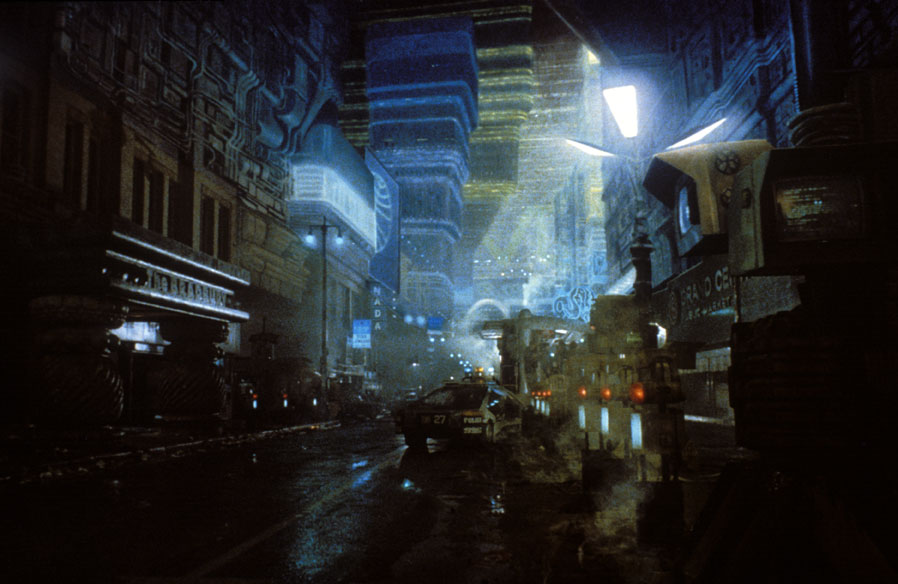
Example 5 & 6: Using films like Terminator and Blade Runner as examples of the futuristic world we want to create for our game. This can be an interesting premise for a fighting game, as this style for a fighting game has not been done before.
This can open up for some very interesting design choices when it comes to my environment.
My Environment plan:
As this is a Futuristic yet realistic environment, I am going to model a street scene completely based around real life. I can then transfer all these assets into looking slightly more futuristic using texturing and other techniques.
I am going to set the level in an American City, due to the scale of their landscapes being much larger than that of many other countries.
Concept sketches to follow shortly, when sketching of 3d assets begin.
Research Report:
For my research report, I'm looking into how video game marketing/publicity techniques can effect the outcome of a games success. It's going to be an industry report. I've opted to do this because the marketing side of video games is an area I'm hugely into, and is somewhere I would love to end up given my competitive background.
The industry report is going to consist of actual techniques and mindsets that developers/publishers have when marketing a game to an audience, and how these techniques will assist in selling the game to the wide audience.
Industry Questions:
One of my contacts within industry has agreed to answer some questions based on what I'm looking for in my report. For privacy reasons, I am not allowed to use their name, nor the company they work for in my report. As the answers are their personal opinion, and do not reflect that of their company.
Unfortunately, I am unable to use this interview as primary research in my report, as the legitimacy cannot be confirmed due to the privacy I must respect. However, for research purposes and for the content within this interview, I will take some terms and techniques named. And I will be looking into those, and branching off of them to find working examples of them being used, and how successful they have proven to be. Or unsuccessful, whatever the case may be.
These are the answers they gave.
[Me] Video games seem to be getting more and more spotlight as the years go by, do you think this is caused by the content within the game? Or is this due to the marketing techniques companies utilize?
[Contact] Overall I would say that this cycle of console (what we call current gen) have been very favourable to the industry; Nintendo with the Wii has manage to democratize the game industry and reach an entire new audience: girls, parents and even grand parents. The issue with the wii and the casual gaming is that they didn’t manage to convert casual gamers into gamers, which is why we are seeing a decline in 2012 onward
The industry itself in the space of 2 console cycles has become more professional and has learnt to target not only core gamers but the mainstream audience. Seducing the mainstream with marketing creative is a complete different job than seducing the core gamers; no sure if that answers your questions about techniques but here is an example; despite what everyone thinks, talking to a core gamers about one upcoming game is super easy: you just need to build a creative on yoru game that looks awesone (that is indeed if your game is good); now to be able to talk/owe the mainstream audience you need to be a bit more creative; this audience buys only one to 3 games a year so they are after big hit game or have seen something super cool on TV or there friend are playing that game and they want to be part of the buzz; bottom line you need to first design a kick ass CGI TV spot/trailer to really owe them (Gamers hate that because they don’t see footage, so the TV spot doesn’t represent what will be the game at all), once that is built and tested, well you need to spend huge investment to go on TV and to hit mainstream we are talking about the massive TV program that attracts everyone: X factor, football game…
Those are the very basic technique – Social channel, grass root campaign, CRM strategy, Retail program are good technique too but are less impactful by the Mass media strategy.
[Contact] Overall I would say that this cycle of console (what we call current gen) have been very favourable to the industry; Nintendo with the Wii has manage to democratize the game industry and reach an entire new audience: girls, parents and even grand parents. The issue with the wii and the casual gaming is that they didn’t manage to convert casual gamers into gamers, which is why we are seeing a decline in 2012 onward
The industry itself in the space of 2 console cycles has become more professional and has learnt to target not only core gamers but the mainstream audience. Seducing the mainstream with marketing creative is a complete different job than seducing the core gamers; no sure if that answers your questions about techniques but here is an example; despite what everyone thinks, talking to a core gamers about one upcoming game is super easy: you just need to build a creative on yoru game that looks awesone (that is indeed if your game is good); now to be able to talk/owe the mainstream audience you need to be a bit more creative; this audience buys only one to 3 games a year so they are after big hit game or have seen something super cool on TV or there friend are playing that game and they want to be part of the buzz; bottom line you need to first design a kick ass CGI TV spot/trailer to really owe them (Gamers hate that because they don’t see footage, so the TV spot doesn’t represent what will be the game at all), once that is built and tested, well you need to spend huge investment to go on TV and to hit mainstream we are talking about the massive TV program that attracts everyone: X factor, football game…
Those are the very basic technique – Social channel, grass root campaign, CRM strategy, Retail program are good technique too but are less impactful by the Mass media strategy.
[Me] Do you feel that bad publicity can also heavily effect the success of a video game? naming Call of Duty's airport massacre as an example. [Contact] I won’t call this bad publicity but rather negative one. My answer on this example is no – every gamer want to play violent and realistic game; GTA made this kind of publicity a mark of fabric – the more trash you talk about those games the more people talk about them the more they will be likely to buy them. Now if PR is saying your bad is poor, that makes it hard to sell
Some gaming company can afford to have negative publicity on there game: such as RS or Acti because at the end of the day the only revenue they make is out of games; others can’t afford such publicity sicne it might impact there entire business: Disney or WB for instance; those studio can’t be seen as being the advocate of free violence as it will damage there image and result in performance drop on there other line of business. Welcome to the other side.
Some gaming company can afford to have negative publicity on there game: such as RS or Acti because at the end of the day the only revenue they make is out of games; others can’t afford such publicity sicne it might impact there entire business: Disney or WB for instance; those studio can’t be seen as being the advocate of free violence as it will damage there image and result in performance drop on there other line of business. Welcome to the other side.
[Me]What do you think of when it comes to selling a video game to a specific target audience? For specific genres such as fighting games.
[Contact] Selling a video game to a specific audience is very easy; but with cost of video games rising, publisher cannot longer sell to only one audience; they need to sell there game to the mainstream audience – Let me give you pure facts: there is roughly 1M fighting gamers in Europe; my forecast on MK was around 1M person; I could have targeted only fighting gamers but those guys were SF or Tekken big fans and won’t necessarly have bought MK, so we had to target the fighting gamers but the mainstream as well to bring as much people in. the challenge with MK was the rating; with a BBFC 18 on the pack you can’t do TV before 11pm or target anyone you want so we had to be creative and so forth – in general, most publisher faces the same challenge.
[Contact] Selling a video game to a specific audience is very easy; but with cost of video games rising, publisher cannot longer sell to only one audience; they need to sell there game to the mainstream audience – Let me give you pure facts: there is roughly 1M fighting gamers in Europe; my forecast on MK was around 1M person; I could have targeted only fighting gamers but those guys were SF or Tekken big fans and won’t necessarly have bought MK, so we had to target the fighting gamers but the mainstream as well to bring as much people in. the challenge with MK was the rating; with a BBFC 18 on the pack you can’t do TV before 11pm or target anyone you want so we had to be creative and so forth – in general, most publisher faces the same challenge.
[Me] If there's anything you would like to add, it would be incredibly helpful. I'm just trying to get some first hand research if possible. As this is an industry report, I found it pretty important to try and get some insight from someone who works in that area. [Contact] Try to read MCV the magazine – there is always some good insight on the market + industry in the UK.
Thanks ever so much.
Techniques:
Multiple techniques of marketing were mentioned in this interview, for research for the report, I plan on looking into them, and try to find working examples of companies using these techniques on their games, and finding out how successful these techniques proved to be.
Grass Roots Campaign:
A way of marketing a game to the public via individual movements as opposed to mass media advertising. This also means low cost marketing, in the form of youtube videos, websites or contests.
Ways of enticing the public into taking part in the game being sold whilst selling it to them at the same time. An example of this could arguably be When Warner Brothers held an international Mortal Kombat tournament all around Europe, or when Capcom held the string of Capcom fight clubs, which involved Street Fighter x Tekken going around the Country, and the public could attend to these events free of charge, play the game before it was released and win things whilst being there. This works multiple ways. Due to it's marketing tactics, such as the international tournament and pre release bonuses, Mortal Kombat sold 3 million units in it's first year. Although Street Fighter x Tekken was considered a flop, everyone was really excited for the game before it was released, and the excitement gave it a great launch.
Although in the long run, the numbers of people attending these kinds of events is relatively low for marketing standards (roughly 200 people depending on where it's held,) This can work well when word of mouth is concerned. Something that also comes into the definition of Grass Roots marketing.
Other events such as cons such as the MCM Expo are also an example. Developers/Publishers all over the events try different methods to entice the public in to try their game. Whether it's T shirt giveaways or small contests involving trying the game out.
CRM Strategy:
CRM stands for Customer relationship management. As described by destinationcrm.com..
"CRM, or Customer Relationship Management, is a company-wide business strategy designed to reduce costs and increase profitability by solidifying customer loyalty. True CRM brings together information from all data sources within an organization (and where appropriate, from outside the organization) to give one, holistic view of each customer in real time. This allows customer facing employees in such areas as sales, customer support, and marketing to make quick yet informed decisions on everything from cross-selling and upselling opportunities to target marketing strategies to competitive positioning tactics.""CRM is not without its challenges. For CRM to be truly effective, an organization must convince its staff that change is good and that CRM will benefit them. Then it must analyze its business processes to decide which need to be reengineered and how best to go about it. Next is to decide what kind of customer information is relevant and how it will be used. Finally, a team of carefully selected executives must choose the right technology to automate what it is that needs to be automated. This process, depending upon the size of the company and the breadth of data, can take anywhere from a few weeks to a year or more. And although some firms are using Web-based CRM technologies for only hundreds of dollars per month per user, large companies may spends millions to purchase, install, and customize the technology required to support its CRM initiative."
This is an expensive process for some larger companies, as the money that goes into the technology for these automated services is a wide amount. However, as Customer relationships are they key to a companies success, these steps are seen as extremely necessary. For a company to understand the best actions to take in keeping the customer satisfied, but most importantly, understanding the customer.
Magazine Reports:
Taking my contacts advice, I checked out a few articles based on marketing to find out if I could see anything interesting. I found an article on THQ cutting marketing teams to allow more funding to go into their development team. This article was acquired from MCVUK.com
THQ cutting marketing jobs to bolster development effort
In its ongoing restructuring effort, THQ has let go of 20 employees from its marketing and production staff; stating that the moves will subsequently be used to boost the company’s development side.
An internal memo, apparently penned by THQ president Jason Rubin and published by 3D Realms founder Geroge Broussard, was sent out to staff earlier this week. In it, Rubin outlines plans for layoffs in the aforementioned departments and makes it clear that the move is to have no impact on the development teams and titles in production.
"It is worth pointing out that none of the development teams are effected, and we do not anticipate the reduction to have any impact whatsoever on the titles in production or the future scale of our output. “
It is also quite likely that in the long run the company will hire new individuals with different skill sets in their stead. To put this in perspective, Volition alone anticipates growing by about 20 individuals in the next 12 months."
Rubin states the change represents a shifting of resources from oversight to production.
A THQ rep has since provided a statement to Joystiq:
"THQ confirms a realignment has taken place in the company's marketing and production groups in Agoura Hills. This change is reflective of the company's ongoing strategy to create a more focused, agile, and digitally-oriented organization. Less than 3% of the company's global workforce was impacted, and no development teams or projects were affected by this action."
This article focuses on the ad campaign for the latest Halo game on the Xbox 360. It describes how the marketing campaign has had the largest out house budget put into it from Xbox in the UK.
Tomorrow's Halo 4 launch to conquer the UK
It will impossible to escape the launch of Halo 4 this week as the Xbox team prepares its most ambitious campaign to date.
Master Chief’s latest adventure – released tomorrow (November 6th) – will be supported by the biggest out of house budget Xbox UK has ever spent on a game, the platform holder told MCV.
Halo 4 will take over the London IMAX – just as Halo 3 did – with more stand-out ads in London Underground stations and major shopping centres. There will also be billboards around the UK.
Microsoft is planning a ‘spectacular stunt’ for launch night (November 5th), which will take place along the Thames between The O2 Stadium and Tower Bridge. This will kick off 350 midnight openings, headlined by GAME’s Westfield Stratford store.
And that’s on top of a month-long cinema push with trailers running before Skyfall, and partnerships with Mountain Dew and Pizza Hut.
TV advertising began last week, with spots running around Premiership football matches, movies, The X Factor and more .Throughout the summer, Microsoft has been driving pre-orders with online and print ads, as well as retail promotions and POS.
It has also produced a live-action web series, Forward Unto Dawn, to serve as a prequel to Halo 4.

Example 7: Microsoft teamed up with Mountain Dew UK to offer in game codes and unlockables to customers.

Example 8: Microsoft also teamed up with Dominos to provide a similar offer for customers that bought a specific type of pizza. This kind of viral marketing is partially what caused Xbox UK to cash out the largest budget in terms of advertising to date.
CRM for the Video Game Industry: Tough Crowd
The audience for video games is zealous but fickle, and because of that, game studios have a unique challenge in attracting and retaining customers. While the tools they use are similar to those of other industries, studios have learned to be creative in the marketing tactics that support the effort.
Attracting and retaining fans are the keys to success in the crowded and competitive online games industry. The Net's growing multimedia communications capabilities are providing not only games developers but businesses of every size and stripe a vastly richer yet less structured environment for CRM; something game developers and distributors are very much aware of and keen to plug into.
The emergence of massively multiplayer online games presents online games developers with unparalleled opportunities to reach a worldwide audience of primarily young, highly motivated fans. Attracting them and keeping them coming back requires extra effort, however.
"Customers in the video game industry tend to be young. They tend to prefer communication through electronic channels such as e-mail, chat and Web self-service, rather than the phone. In fact, our clients in this sector are experiencing significant growth in the volume of customer communications through these channels. This means that businesses in this sector need to have a high degree of competence, especially in handling e-channel customer communications -- this is often called 'eService,'" eGains vice president of worldwide marketing, Anand Subramaniam, told CRM Buyer.
http://www.destinationcrm.com/Articles/CRM-News/Daily-News/What-Is-CRM-46033.aspx
http://www.crmbuyer.com/story/63458.html
After a feedback sessions I received, I was instructed to look at what marketing is at heart, and base my first chapter on marketing at it's core.
Marketing, what is it?:
It has been said that Marketing started in Germany in a street that housed three tailors. The first tailor decided to put a sign outside his shop it said: “the best tailor in Germany”. And his sales went up. After some time, the second tailor in the same street decided to use the same strategy and created a different sign that read: “I´m the best tailor in the world”. And his sales increased even more than those of the first one. The third tailor, after weeks of watching his sales decline, decided to change the message and wrote: “I´m the best tailor in this street”. And so, Marketing was born as the greatest sales force. The 3 tailors where able to differentiate themselves from one another, although there was no change to the quality of their clothing. The process started in a closed organization or context, fighting with other memes to push their (more real or less real) identities outside.
www.investopedia.com
http://www.destinationcrm.com/Articles/CRM-News/Daily-News/What-Is-CRM-46033.aspx
http://www.crmbuyer.com/story/63458.html
After a feedback sessions I received, I was instructed to look at what marketing is at heart, and base my first chapter on marketing at it's core.
Marketing, what is it?:
Definition of Marketing
The following definitions were approved by the American Marketing Association Board of Directors:
Marketing:
Marketing is the activity, set of institutions, and processes for creating, communicating, delivering, and exchanging offerings that have value for customers, clients, partners, and society at large. (Approved October 2007)
Marketing Research:
Marketing research is the function that links the consumer, customer, and public to the marketer through information--information used to identify and define marketing opportunities and problems; generate, refine, and evaluate marketing actions; monitor marketing performance; and improve understanding of marketing as a process. Marketing research specifies the information required to address these issues, designs the method for collecting information, manages and implements the data collection process, analyzes the results, and communicates the findings and their implications. (Approved October 2004)
www.Marketingpower.com
www.Marketingpower.com
It has been said that Marketing started in Germany in a street that housed three tailors. The first tailor decided to put a sign outside his shop it said: “the best tailor in Germany”. And his sales went up. After some time, the second tailor in the same street decided to use the same strategy and created a different sign that read: “I´m the best tailor in the world”. And his sales increased even more than those of the first one. The third tailor, after weeks of watching his sales decline, decided to change the message and wrote: “I´m the best tailor in this street”. And so, Marketing was born as the greatest sales force. The 3 tailors where able to differentiate themselves from one another, although there was no change to the quality of their clothing. The process started in a closed organization or context, fighting with other memes to push their (more real or less real) identities outside.
For decades, this story has been the essence of marketing. "It´s not important if the product is better or worse, or if there really is product differentiation, or even if it adds some value to society. The more your message is repeated and reinforced in an appealing way to your target market, the more believable and the more truthful your message will become".
The four P's of Marketing:
Every Marketing student is taught the four P's of marketing, if you understand these than the chance of your business/company becoming successful is much more realistic.
These are Product, Placement, Price and Promotion. Creating a marketing strategy that deals with all four of these matters correctly, according to the organizations resources, will likely lead to business success.
Definition of 'Four Ps'
The categories that can be controlled in the marketing of a good or service: product, price, place and promotion. The four Ps, often referred to as the marketing mix, are all constrained by internal and external factors in the overall environment. Designs made in the "product" component determine the name, design and packaging of the good. "price" involves the cost of the good and if volume or seasonal discounts will be offered. "place" decisions outline where the product will be sold and how it will be delivered to the market. "promotion" involves advertising, public relations and promotional strategy.
www.investopedia.com
www.Commonsmarketing.org
4 Lessons from Video Game marketing:
Whilst looking online for sources and information, I stumbled across this article on Imediaconnection.com that covered 4 lessons from video game marketing. These have been compiled together based on their experience when it comes to working with some of the most successful companies in the world.
Some of today's most advanced online marketing strategies are being applied in the video game industry. The digital environment is the perfect space to market a digital product, and the male youth target had been difficult to reach before they all congregated on the web.
The powerful combination of digital advertising for a digital product in a digital environment has meant that game marketers have a greater ability to measure the effectiveness of their advertising, tracking at least some portion of sales and customer lifetime values in ways that are still elusive to other marketers. Video game marketers strive to build their brands but can also measure the real-world effectiveness of, and return, on their online advertising with the detail and precision of direct marketers. This has yielded data that have changed the way we approach brand marketing.
Here are a few things we've learned in our experience working with some of the leading gaming brands in the world.
As Technology changes, so does your target market, and your means of reaching them
n the last half-dozen years, the gaming market has changed dramatically. What has been traditionally the domain of young males has expanded greatly. Online games, social games, and mobile games have significantly expanded the audience. Today, somewhere around 60 to 70 percent of all Americans play video games. In social gaming, women make up the majority of players. These new female players are as passionate as, or more passionate than, their male antecedents. According to a 2011 study by Doritos, the majority of women stated they preferred online gaming over shopping or sex.
In a short period, the media universe for our clients changed dramatically. Traditional media outlets to reach gamers were still important for a segment of the market, but many new players entered the mix. Traditional audience metrics, demographics, and psychographics proved to be instructive as an initial guide to media planning, but the true value of media could only be judged by experimentation. Two major media outlets targeting nearly identical audiences with similar creative executions and costs could have dramatically different effects on sales. Maddeningly, these discrepancies in media performance are not always consistent, and every buy provides new insights.
Creative: Don't put all your eggs in one basket
Running an ad campaign with a single style of execution is like putting all your retirement savings in a single stock. Creative diversification is a relatively inexpensive cost compared to media budgets, and a properly optimized creative mix can multiply the effectiveness of your media spend several times over. But few advertisers embrace this approach, despite the proven results.
One area that has been particularly effective is interactivity and gaming within ad units themselves. Everyone likes to take a break and "play," if only to see what's new, different, and entertaining on the web. We've all heard that "engagement is the new reach," but while raw reach numbers will always remain important, engagement analytics are quickly catching up as an equally significant metric. And, if engagement is assessed based on the length of time a user interacts with an ad, what's more engaging than a game?
Entertainment and consumer packaged goods (CPG) marketers are already on to this, and while promotional microsite games are losing ground to Facebook executions, creating an immediate opportunity to play around within a display ad is a compelling, measurable, and creative strategy that establishes a positive emotional association with a brand.
Of course, this approach can be abused with negative consequences. The "gamification" of brands can only be effective if there's some inherent element of competitive discovery of a relevant outcome. The user should be rewarded with a benefit tantamount to the brand experience, which is easier for video games as the brand experience is play.
The Media plan is just the beginning
Often, by the time one of our campaigns finishes, we will only be using half the sites with which we initially started. There may be several additional sites added that were not part of the initial mix. Why, after doing this for over a decade, with hundreds of gaming campaigns under our belt, can't we accurately predict what sites will perform the best with anything better than 50 percent accuracy?
Agencies love to say that "every campaign is different," but few act as if this were truly the case. Every campaign is different, not because the media plans change, but for the same reason Heraclitus said you can never step in the same river twice: "All entities move and nothing remains still." This is especially true of the gaming-media landscape and customer base. It is also increasingly true of all marketing efforts.
Most agencies work to create and execute on a single media plan with the expectation that it will be successful based on past experience. In the gaming space, because there is so much change, we approach buys with both plans and contingency plans, and look at the constant change as part of the process, rather than the result of failure.
The Future of advertising is very Geeky
While the historical definition of gamers as geeky kids may be inaccurate, the future of advertising looks very geeky. Our media departments need to act like scientists and researchers, treating each campaign as a new experiment. In our creative departments, skilled programmers are taking their places alongside designers and copywriters.
Strategy and execution are no longer etched in stone. The days of simply establishing creative and media plans then executing them are over. Direct marketers have always known that every marketing effort yields two things: sales and information. What doesn't work is as illuminating as what does. It's not unusual to test a dozen creative approaches at once, across hundreds of relevant sites. Online advertising programs are simultaneously research projects. Optimizing target audience identification, creative effectiveness, and media efficiencies are all baked into execution.
This report was written by Will Akerlof, The president and Co Founder of Liquid Advertising.
Link to a number of quotations from users on World of Warcraft forums about their customer feedback and support.
http://us.battle.net/wow/en/forum/topic/6201371123
Little big Planet advert:


The Nintendo DS in itself I believe to be a prime example of advertisements being crystal clear.
Street fighter x Tekken:
http://games.slashdot.org/story/12/02/14/203247/xbox-360-game-patching-costs-40000
"It costs developers a total of $40,000 to release a single patch on Xbox Live, making it a difficult platform for smaller developers to grow on. This revelation was made by Tim Schafer of Double Fine Studios — which recently drew a lot of charitable donations as part of a campaign to create a contemporary point and click game. He went on to say that this is just too high a fee for smaller developers to pay, making it hard for them to do well on the platform. This makes sense, since requiring just one patch could massively cut into the profits for a company."
Modern Warfare 2 controversy:
http://www.telegraph.co.uk/technology/video-games/6768747/Call-Of-Duty-Modern-Warfare-2-defies-controversy.html
In light of the praise heaped on Generation Kill, the verbal exchange in Modern Warfare 2 that is currently under the spotlight seems strange. After all, one of the calling cards of the entire Call Of Duty series is its focus on making the atmosphere of war - if not the immediate consequences - feel as realistic as possible. Given the franchise's authentic bent, the dialogue under scrutiny could easily be dismissed as being a legitimate example what one might hear if they were stationed in the Middle East. The latest complaints about Modern Warfare 2 also seem particularly wrong-headed in light of the controversy the game has already steamrolled through. After all, if killing civilians isn't enough to stop this juggernaut, what makes anyone think five lines of dialogue is going to?
http://www.forbes.com/sites/erikkain/2012/12/07/call-of-duty-black-ops-2-sales-dont-point-to-franchises-decline/

Link to a number of quotations from users on World of Warcraft forums about their customer feedback and support.
http://us.battle.net/wow/en/forum/topic/6201371123
Little big Planet advert:

The Advertisements on the television for Little Big
Planet were interesting from a knowledgeable gamers perspective. As
they were showcasing that you could create whatever your mind could
think up, there were a number of different adverts, all showcasing
different user created levels with a narrator describing what the
character is doing as he navigates it. However, what Dan is talking
about is the fact that although a knowledgeable fan would know that
they're showcasing that anything is possible, the advert never
actually addresses that. To the unsuspecting gamer, the game is
simply just a 2d platformer. I personally can vouch for that
statement, As I do not own a Playstation 3, and especially back when
LBP was due to come out, I didn't know what the game contained, and I
was equally as puzzled as the next person after viewing the adverts
on the tv.Not all companies presume the audience knows what they're talking about, and will try to educate the viewer about their product before getting them to buy it.

The Nintendo DS in itself I believe to be a prime example of advertisements being crystal clear.
Street fighter x Tekken:
http://games.slashdot.org/story/12/02/14/203247/xbox-360-game-patching-costs-40000
"It costs developers a total of $40,000 to release a single patch on Xbox Live, making it a difficult platform for smaller developers to grow on. This revelation was made by Tim Schafer of Double Fine Studios — which recently drew a lot of charitable donations as part of a campaign to create a contemporary point and click game. He went on to say that this is just too high a fee for smaller developers to pay, making it hard for them to do well on the platform. This makes sense, since requiring just one patch could massively cut into the profits for a company."
Modern Warfare 2 controversy:
http://www.telegraph.co.uk/technology/video-games/6768747/Call-Of-Duty-Modern-Warfare-2-defies-controversy.html
This week Call Of Duty: Modern Warfare 2 made the news again when it emerged the record breaking video game contained a joke which some construed as homophobic. It is the latest in a long line of controversial news stories about Infinity Wards' first-person-shooter (FPS); the game has already been slammed for containing a mission in the campaign mode in which the player guns down unarmed civilians, and there are rumours this level may have lead to plans for a ban in Russia. Now some macho dialogue from a couple of soldiers in the game has attracted more attention to Modern Warfare 2 for all the wrong reasons.
The above monologue, however, isn't from Modern Warfare 2. It's from a critically acclaimed award winning HBO mini-series called Generation Kill. This tirade spews forth from the mouth from one of the show's characters - a U.S. Marine - in response to a letter from a child who has written to the troops in Iraq to show his support. His letter expresses the wish that they all return in one piece and that the war end soon. He signs off by saying that he's hopeful the troops may be able to come home without ever having to fight. As the above statement shows, the troops in Generation Kill don't share his sentiments. "Where is this weak-a** child from?" says one of them, who then launches into the scornful tirade above. His language drips with machismo and testosterone and in any civilised context it would be look as hurtful, mean and borderline homophobic. At the very least we can all agree it's not exactly politically correct.
Based on the excellent war reportage book by Rolling Stone journalist Evan Wright, Generation Kill is a gritty and unblinking look at the realities faced by troops who fought in the recent Iraq war. The series was written for television by David Simon and Ed Burns, the men behind one of the best television series of its generation, The Wire, and much of its dialogue captures the macho, pugnacious worldview of its subjects. It wouldn't be remiss to say that the above monologue could be viewed as the sort of language used by soldiers serving in the U.S. Marine Corps. It's also worth pointing out that this dialogue didn't earn anyone involved in Generation Kill the notoriety that the tiny exchange in Modern Warfare 2 seems to have merited for Infinity Ward and Activision. In fact, it's doubtful it got any attention at all.
http://www.forbes.com/sites/erikkain/2012/12/07/call-of-duty-black-ops-2-sales-dont-point-to-franchises-decline/
Successful games without marketing:
Minecraft:
http://kotaku.com/5724989/why-minecraft-is-so-damn-popular
https://www.techdirt.com/articles/20101004/02172611272/minecraft-s-developer-making-350-000-100-000-per-day-updated.shtml
We've been writing a few stories about Minecraft lately, kicking off with a discussion about how developer Markus Persson doesn't worry about "piracy," because he feels it's better to focus ongiving people a reason to buy than caring about what others are doing. More recently, there was a big discussion around the simple coolness of a guy in Minecraft building a working computer within the game itself. Both were neat stories.
Now Jay sends in some news that continues to build on the legend of Minecraft, pointing to a story claiming that Persson is making $350,000 per day (see the update below). With alpha software, and without going after "pirates" who are supposedly destroying the industry. Yeah. Apparently, he's selling a copy every 3 seconds. And he's done all this with no distribution. No retail deals. Just creating a really good game, getting people interested in it, not treating them like criminals, and giving them a reason to buy.
Whatever happened to "pirates" killing the gaming market, huh?
Update: There's some discussion in the comments about this, and I hadn't realized that Perssonposts sales stats publicly. From that, it looks like the $350k per day claim was a bit exaggerated -- though, there was one such day. It looks like a more typical day is closer to $100,000. Still seems like a pretty damn good success story.
http://www.edge-online.com/news/yogscast-credit-us-minecrafts-success/
gamezebo.com state that in 2012 Minecraft sold 15 million units.
Minecraft:
http://kotaku.com/5724989/why-minecraft-is-so-damn-popular
Minecraft was the undisputed indie success story of 2010. Yet much of its appeal seems to lie in what it's not, rather than what it is.
It is, first things first (and before I am lynched by Minecraft fans), a good game. Maybe even a great game. It's got an iconic look, it's widely accessible, it allows gamers to create their own stories, and perhaps most engrossing of all, has an initial simplicity and ease of play that quickly gives way to a complexity as deep as the mines you'll soon find yourself digging.
Yet I don't think that's the only reason the game has been such a hit.
There are plenty of games that offer experiences just like those above that would count themselves lucky to sell half that many copies. And they're usually more polished to boot.
But those games are spat out of a machine, one that many serious and long-time gamers have grown increasingly wary of. They are preceded for months (and sometimes years) by marketing double-speak, cinematic trailers, developer diaries, E3 demonstrations, annoying website ads and breathless preview coverage.
You've never seen its creator, Markus "Notch" Persson, interviewed by Geoff Keighley about how amazing his amazing new game is going to be. Or heard a publisher enthuse about how many millions of units it's expected to ship this financial year.
It gave life to a community where gamers could gather in substantial force around a game safe in the knowledge their enthusiasm was being generated by the community about the game and not the other way around.
We've been writing a few stories about Minecraft lately, kicking off with a discussion about how developer Markus Persson doesn't worry about "piracy," because he feels it's better to focus ongiving people a reason to buy than caring about what others are doing. More recently, there was a big discussion around the simple coolness of a guy in Minecraft building a working computer within the game itself. Both were neat stories.
Now Jay sends in some news that continues to build on the legend of Minecraft, pointing to a story claiming that Persson is making $350,000 per day (see the update below). With alpha software, and without going after "pirates" who are supposedly destroying the industry. Yeah. Apparently, he's selling a copy every 3 seconds. And he's done all this with no distribution. No retail deals. Just creating a really good game, getting people interested in it, not treating them like criminals, and giving them a reason to buy.
Whatever happened to "pirates" killing the gaming market, huh?
Update: There's some discussion in the comments about this, and I hadn't realized that Perssonposts sales stats publicly. From that, it looks like the $350k per day claim was a bit exaggerated -- though, there was one such day. It looks like a more typical day is closer to $100,000. Still seems like a pretty damn good success story.
http://www.edge-online.com/news/yogscast-credit-us-minecrafts-success/
gamezebo.com state that in 2012 Minecraft sold 15 million units.

No comments:
Post a Comment